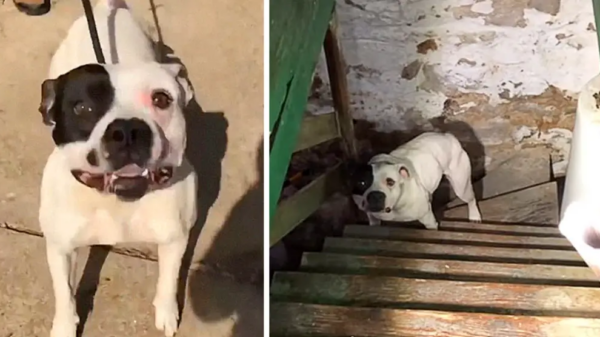







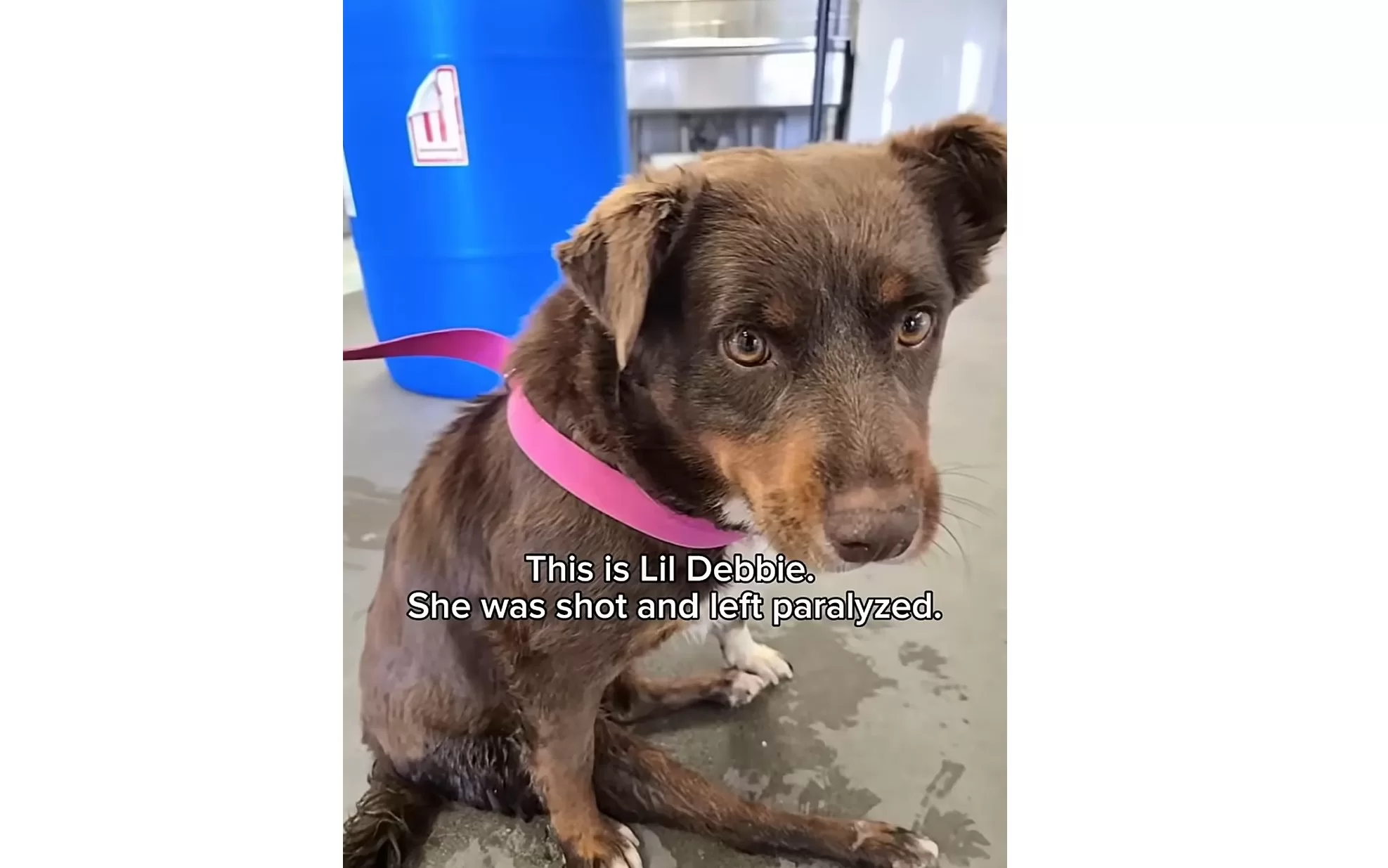

When Lil Debbie arrived at an animal shelter in Arizona, her back legs dragged behind her.
Nobody knew exactly what had happened. A veterinarian believed the young dog was living with an old injury, but could not say whether the paralysis was permanent.
She was only about two years old.
Despite her condition, Lil Debbie remained alert, affectionate and full of energy. Shelter workers quickly realized that she was not giving up.
They decided not to give up on her either.
The shelter began asking for help
Lil Debbie was taken to Holbrook Animal Care & Control, where staff members gave her a safe place to rest and began sharing photographs and videos online.
They hoped an experienced rescue group would see her story and offer the specialized care she needed.
Caring for a dog with limited mobility can be difficult for a small shelter. Lil Debbie needed medical evaluations, rehabilitation and equipment that would allow her to move without damaging her skin or joints.
The shelter could keep her safe, but she needed a longer-term plan.
Eventually, help arrived.
A wheelchair gave her freedom
Lil Debbie was transferred into rescue care and fitted with a small wheelchair.
For the first time since arriving at the shelter, she could move without dragging the back half of her body across the ground.
The wheelchair allowed her to explore, play and exercise while keeping pressure off her injured legs.
She adapted quickly.
Videos from her recovery show Lil Debbie moving with confidence, using her front legs to pull the wheelchair forward while her back legs remained supported.
The equipment gave her mobility, but her rescuers also began working on rehabilitation.
They still did not know how much movement she might regain.
Progress came in tiny steps
Recovery was not immediate.
At first, there were only small signs.
A slight movement in one leg. A moment when she appeared to support part of her weight. A few seconds standing before losing her balance.
Each change mattered.
Her caregivers continued with physical therapy and controlled exercise, helping her muscles grow stronger without pushing her too far.
Lil Debbie often fell.
Then she tried again.
Over time, the movements became more noticeable. She began placing her back feet on the ground and attempting to step forward.
The dog who had arrived dragging her legs was starting to stand.
Then she began walking
Her first steps were uncertain.
Lil Debbie moved slowly, with an uneven gait, while her caregivers stayed close. She sometimes lost her balance and needed support.
But she was moving on her own.
With continued therapy, her steps became stronger. She learned how to coordinate her legs again and began covering longer distances without the wheelchair.
Soon, walking was no longer the biggest milestone.
Lil Debbie started running.
The change was captured in videos shared by Best Friends Animal Society. The young dog can be seen moving across the ground on all four legs, energetic and determined.
Her recovery surprised many of the people who had followed her story from the beginning.
Her personality never changed
The most remarkable part of Lil Debbie’s story was not only her physical recovery.
Even when she could not walk, she remained playful and eager to interact with people.
She did not appear to understand that she was different from other dogs.
Her wheelchair was not something that made her unhappy. It was a tool that allowed her to keep living while her body healed.
Her rescuers described her as a small dog with a large personality.
That personality carried her through the hardest parts of rehabilitation.
Dogs with disabilities can still have full lives
Not every paralyzed dog regains the ability to walk.
Some depend on wheelchairs permanently, while others recover partial movement through surgery, rehabilitation or time.
Their quality of life depends on pain levels, overall health and access to proper care.
Mobility equipment can allow disabled dogs to run, play and explore. Many adapt more quickly than people expect.
Lil Debbie’s recovery is unusual, but her early life in a wheelchair was not a failure.
The wheelchair gave her freedom while she worked toward something nobody could promise.
From paralysis to running
When Lil Debbie first arrived at the shelter, there was no guarantee that she would ever stand again.
Her back legs appeared useless. Her future was uncertain, and she needed more care than the shelter could provide alone.
Then a network of people stepped in.
Shelter workers shared her story. Rescuers gave her a wheelchair. Caregivers helped her rebuild strength. Lil Debbie did the rest.
Her first movements became steps.
Her steps became a walk.
And the dog who once dragged her back legs eventually began to run.