
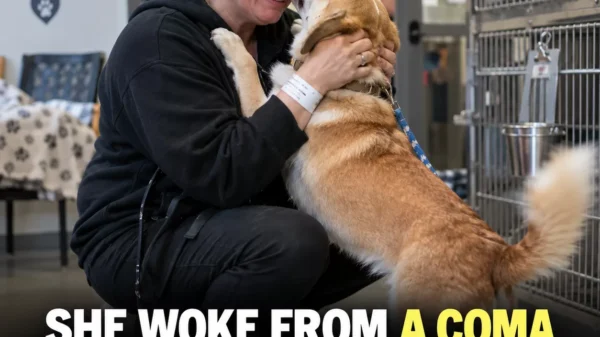






When Ewa Lutka-Krawczyk learned she had gallbladder cancer, her thoughts quickly turned to someone waiting for her at home.
Not to possessions.
Not to unfinished plans.
To Gaja.
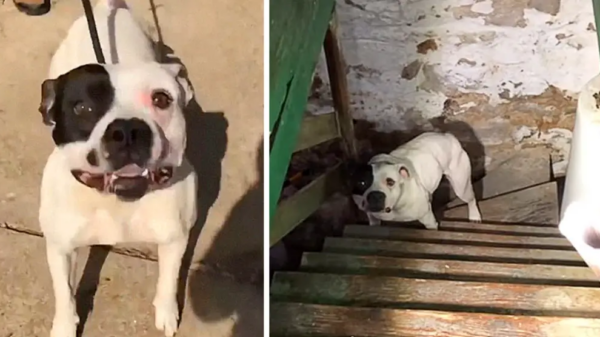
Three years earlier, Ewa had adopted the dog from a shelter. What began as an adoption became a deeply rooted companionship, the kind built through ordinary mornings, walks, familiar footsteps and the quiet certainty that someone will always be there.
Then Ewa became seriously ill.
From her hospital bed in Warsaw, one of her greatest worries was what would happen to Gaja if she never came home.
She even asked her doctor whether she might have a few more years.
Not because she was afraid to die.
Because she could not bear the idea of leaving her dog behind.

At home, Gaja was waiting
As Ewa’s condition worsened, she was admitted to the Palliative Medicine Clinic at the Medical University of Warsaw.
Gaja remained at home with Ewa’s husband.
According to reporting on the case, the dog began eating poorly after Ewa disappeared from her daily routine.
From her hospital bed, Ewa understood exactly what was happening.
Gaja was waiting.
Dogs do not understand diagnoses, palliative medicine or why someone suddenly stops coming through the door.
They understand absence.
And for a deeply bonded animal, that absence can become its own kind of distress.
Poland is now considering changing the rules
Ewa’s story comes as Polish lawmakers consider legislation that would give patients in inpatient hospices and palliative-care wards an explicit right to have contact with their own pets.
The proposal was submitted to the Polish parliament on May 19, 2026, and formally referred to the Health Committee for a first reading on June 17.
As of the end of August, the bill was still in the parliamentary process.
Some hospitals already allow pet visits when conditions permit.
But there is no nationwide guarantee.
That means something as simple as seeing a beloved dog one final time can depend on the policy of an individual facility.
One patient worried about his cats
The push for change was strengthened by another case involving a terminally ill cancer patient who was deeply worried about two cats he had left at home.
When the animals were eventually brought to the ward, the reunion affected not only the patient but also the medical staff who witnessed it.
Dr. Tomasz Dzierżanowski, director of the Palliative Medicine Clinic at the Medical University of Warsaw, has argued that pets can provide an extraordinary form of emotional support near the end of life.
For patients who feel isolated or who have outlived much of their social circle, an animal may represent one of the strongest remaining connections to home.
Therapy dogs help — but your own dog is different
Ewa’s ward already receives visits from therapy dogs.
One of them, an Australian Shepherd named Kluska, was photographed resting beside patients and offering quiet companionship.
Those visits can provide comfort.
But the relationship between a patient and their own animal carries something else.
Recognition.
History.
A familiar smell.
A voice the dog has heard thousands of times.
Years of shared routines that cannot be recreated by a stranger, no matter how gentle that stranger may be.
One last visit can matter to both of them
The proposed law is ultimately about something very simple.
A person nearing the end of life should not necessarily have to say goodbye to a beloved animal from a distance.
And an animal waiting at home should not always have to wonder why its person disappeared.
For Ewa, being able to see Gaja again would not change the diagnosis.
It would not stop time.
But it could turn one painful absence into one final moment together.
Medicine can treat pain.
It can manage symptoms.
It can make a person more comfortable.
Sometimes, however, comfort arrives on four paws.