







A Small Statue with a Heavy Meaning
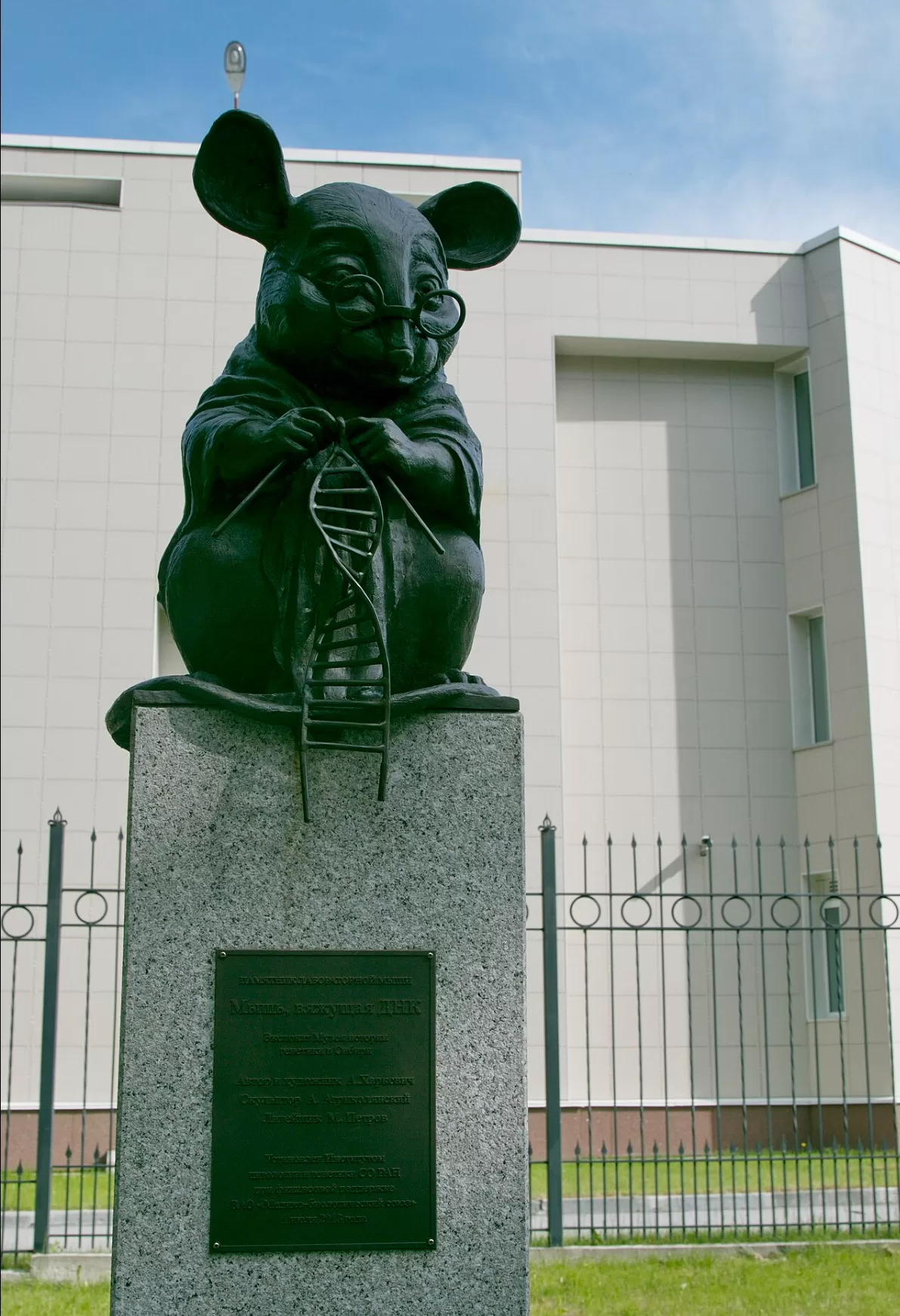
In the vast, often unforgiving landscape of Siberia, in the city of Novosibirsk, there stands a monument that surprises many who encounter it for the first time. It is not large or imposing. It does not depict a famous leader or a historic battle. Instead, it shows a mouse.
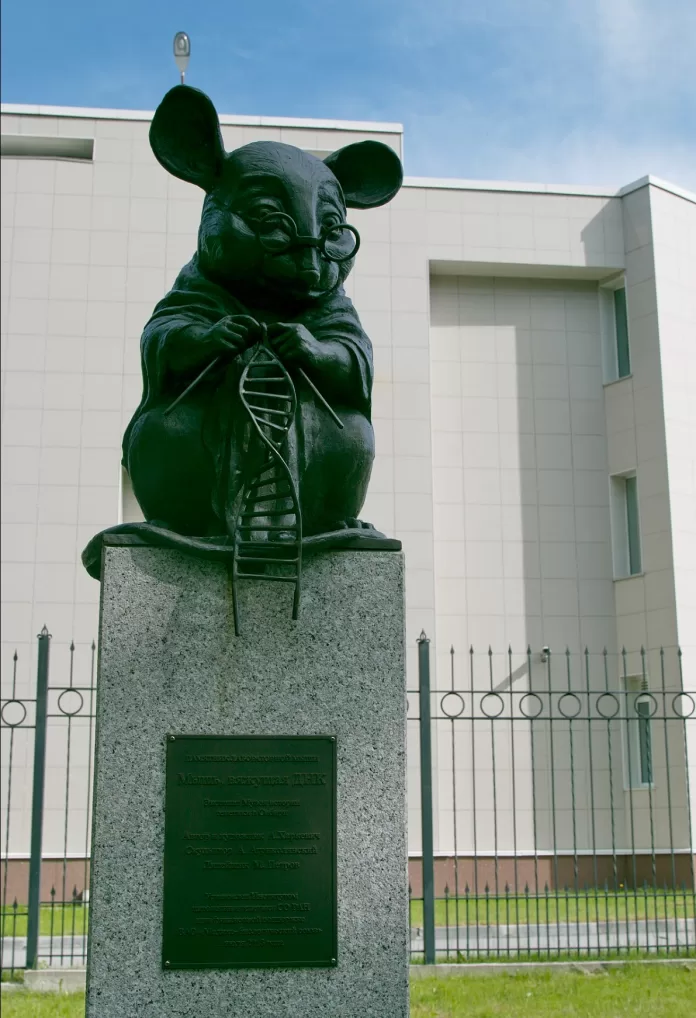
At first glance, the statue may appear whimsical, even humorous. A mouse wearing glasses, sitting upright, carefully knitting with tiny needles. But this monument is not a joke, and it was never intended to be one. It is a deeply serious tribute to millions of lives that quietly shaped modern science and medicine.
This is the monument to the laboratory mouse.
Located at the Heart of Scientific Discovery
The statue stands in front of the Institute of Cytology and Genetics in Novosibirsk, one of Russia’s most important research centers. This is a place where scientists study heredity, evolution, and the biological mechanisms that define life itself.
The choice of location is deliberate. The monument is not placed in a park or tourist square, but directly in front of the institution where generations of researchers have worked with laboratory animals to unlock the secrets of genetics.
Every scientist who enters the building passes this small figure. Every day, it silently reminds them of what their work is built upon.
Not Just a Mouse, but a Symbol
The mouse is depicted holding knitting needles, not food. Between its paws, it carefully weaves a DNA double helix. This image is not accidental. The DNA strand represents the foundation of genetic research, the code that determines inheritance, disease, and development.
By showing the mouse knitting DNA, the monument makes a powerful statement. It suggests patience, repetition, and meticulous effort. Scientific progress does not come from sudden miracles. It comes from countless small steps, repeated experiments, and long-term observation.
The mouse, in this scene, is not passive. It is portrayed as a participant in discovery. A quiet contributor to knowledge that has transformed human life.
The Invisible Contributors to Medicine
Laboratory mice have played an essential role in nearly every major medical breakthrough of the last century. From vaccines and cancer treatments to genetic therapies and understanding hereditary diseases, mice have been central to progress.
Their lives were short. Their presence often unnoticed by the public. Yet without them, many advances would not exist.
This monument acknowledges a truth that science often struggles to confront openly. Progress has a cost. And in the case of biomedical research, that cost has often been paid by animals who had no choice.
Capturing Dignity, Not Sentimentality
The artists behind the monument spent a long time searching for the right expression. They did not want the mouse to appear human. They also did not want it to appear cartoonish or trivial.
What they aimed to capture was a moment of realization. The expression on the mouse’s face suggests concentration, seriousness, and even understanding. As if it has paused in the act of knitting because something has become clear.
This moment reflects the instant of scientific insight. The second when a pattern makes sense. When a hypothesis becomes a conclusion.
By giving the mouse this expression, the monument grants it dignity.
An Ethical Reminder Cast in Bronze
This statue is more than an artistic installation. It is an ethical statement.
It openly acknowledges that many human lives have been saved because countless animal lives were sacrificed. This is not presented as a justification or a celebration, but as a responsibility.
The monument reminds researchers that their work rests on a foundation of loss as well as discovery. It asks for awareness, humility, and care. It does not accuse, but it does not allow forgetting.
In this way, the statue serves as a daily moral checkpoint for those who walk past it.
Why This Monument Matters Today
In a world where scientific advancement is often praised without reflection, this monument slows the conversation. It asks observers to consider not only what we have gained, but how we gained it.
It challenges the idea that progress is clean or effortless. It introduces gratitude into a field often driven by results and deadlines.
By honoring the laboratory mouse, the monument honors all the unnamed animals whose existence made modern medicine possible.
A Quiet Place of Reflection
Visitors often report an unexpected emotional response. What seemed amusing at first becomes sobering upon closer inspection. The small size of the mouse contrasts sharply with the magnitude of what it represents.
It does not demand attention. It waits for it.
In that waiting, it becomes powerful.
Remembering the Unseen
The monument to the laboratory mouse in Novosibirsk stands as a rare acknowledgment of invisible sacrifice. It does not erase ethical debate, nor does it offer simple answers. Instead, it preserves memory.
It reminds us that knowledge has a history, and that history includes lives that never asked to be remembered.
By casting that truth in bronze, the statue ensures that they are not forgotten.